There are colored pencils. There are professional colored pencils. And then there are Caran d'Ache Luminance — a category that sits almost entirely alone at the top.
Luminance are the most lightfast colored pencils commercially available. Not the most lightfast in their price range. The most lightfast, period. If you've ever wondered what's actually at the ceiling of what colored pencils can be, this is it.
Here's what makes them remarkable, who they're genuinely built for, and how to decide whether they belong in your studio.
What Is Lightfastness and Why Does It Matter?
Lightfastness measures how resistant a pigment is to fading when exposed to light. Every colored pencil manufacturer rates their colors on a scale — typically following either the Blue Wool Scale (used in Europe) or the ASTM standard (used in North America).
Most colored pencils, even premium ones, have a mix of lightfast and non-lightfast colors in their range. Prismacolor famously has many colors rated "poor" for lightfastness — beautiful to work with, but they'll fade over years of display.
Caran d'Ache Luminance are rated at LFI (Lightfast Index) 1 or 2 across the entire range — the highest possible ratings. Tested to resist fading for 100+ years under museum display conditions. This is why conservators, archivists, and artists creating work intended to last generations reach for Luminance.
The Swiss Wax Formula: What Makes Luminance Feel Different
Luminance use a proprietary wax-oil blend developed by Caran d'Ache in Switzerland. The formula sits between a pure wax pencil (like Prismacolor) and a pure oil pencil (like Polychromos) — giving you some of the blendability of wax with more of the stability and lightfastness of oil.
In practice, this means:
Exceptionally smooth laydown. Even on the first stroke, Luminance deposit pigment evenly and richly. Artists often describe the feel as "like drawing with silk" — not the slight drag of Polychromos or the occasional chunkiness of a fresh Prismacolor.
Minimal wax bloom. The oil component in the binder significantly reduces bloom compared to pure wax pencils. You may see it in very heavy applications but it's much less pronounced than with Prismacolor.
Excellent layering depth. Luminance accept a remarkable number of layers — even more than Polychromos in many cases — before the paper tooth fills completely. Professional artists regularly build 15–20 layers in detailed work.
The 100-Color Range
Luminance come in 100 colors — smaller than Polychromos (120) or Prismacolor (150), but curated with intention. Every color in the range was chosen for its permanence, which means some of the vibrant but fugitive pigments you'll find in other brands simply aren't here.
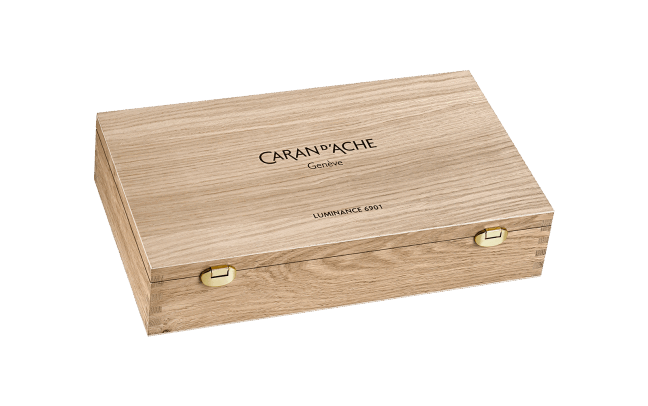
Caran d’Ache presents a light oak wooden case showcasing the luminance 6901™ coloured pencil range, manufactured in Geneva.
What this range does extraordinarily well:
Skin tones: The Luminance skin tone family is considered by many portrait artists to be the finest available in any colored pencil brand. The nuance in the mid-range flesh tones — the subtle warm-cool shifts that make skin look alive — is genuinely unmatched.
Subtle neutrals: Colors like Chinese White (001), Naples Ochre (035), and Raw Umber (049) have a richness and depth that makes neutrals feel luminous rather than flat.
Deep blues and indigos: Indigo (135), Ultramarine (140), and Night Blue (159) are stunning — rich, fully saturated, and they layer without muddying.
What's missing: Very bright fluorescents and certain vivid magentas — pigments that are inherently fugitive and can't meet the lightfastness standard. If your work depends on neon or very bright hot pinks, you'll need to supplement with another brand for those specific colors.
Who Should Buy Luminance?
Portrait artists: If you do realistic portrait work and care about your finished pieces lasting, Luminance are the professional standard. The skin tone range alone justifies the investment.
Artists selling or exhibiting work: If buyers are paying for your art, they deserve work that won't fade. Luminance gives you that assurance on paper.
Botanical and natural history illustration: A discipline with a 400-year tradition of archival standards. Luminance fit directly into that lineage.
Serious hobbyists who want their best work to last: You don't have to be a professional for your artwork to matter to you. If you've created pieces you care about preserving, Luminance are worth the premium.
Beginners or casual colorists: Probably not yet. The cost per pencil is high, and the blending technique rewards experience. Build your skills with Prismacolor or Polychromos first — Luminance will be waiting when you're ready.
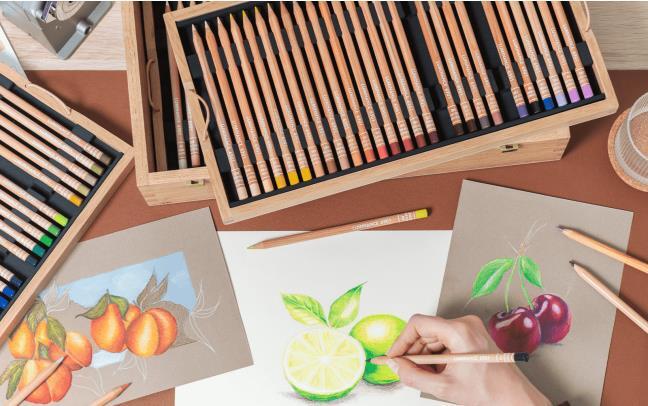
With their smooth, wax-based lead, these artist-grade pencils offer exceptional lightfastness that meets the ASTM D-6901 standard, ensuring durability for up to 100 years.
The Price Conversation
Luminance are the most expensive mainstream colored pencils available. A single pencil runs $4–6, and sets range from $60 (12-piece) to $600+ (100-piece). That's not a typo.
The counterargument is simple: if you're investing serious time in a piece — 20, 30, 40 hours of detailed work — the pencil cost is a small fraction of the total investment. Using non-lightfast pencils on a piece you've spent a month creating is a false economy.
Buy them for the work that matters most. Use Polychromos or Prismacolor for studies, practice, and everyday coloring.
Finding Luminance Matches for Any Color
Want to know which Luminance color matches a hex code from a reference photo, or find the Luminance equivalent for a Copic or Polychromos you love?
Upload your reference at MyKindofColor and filter by Caran d'Ache Luminance. You'll get the exact color number and name with a match quality rating — no swatch books required.
Shop Caran d'Ache Luminance on Amazon →
---
The complete Caran d'Ache Luminance 6901 range is indexed in MyKindofColor. Match any photo, screenshot, or hex code to the exact Luminance pencil number — and cross-reference against Polychromos, Prismacolor, and more.